The platform my dissertation research required.

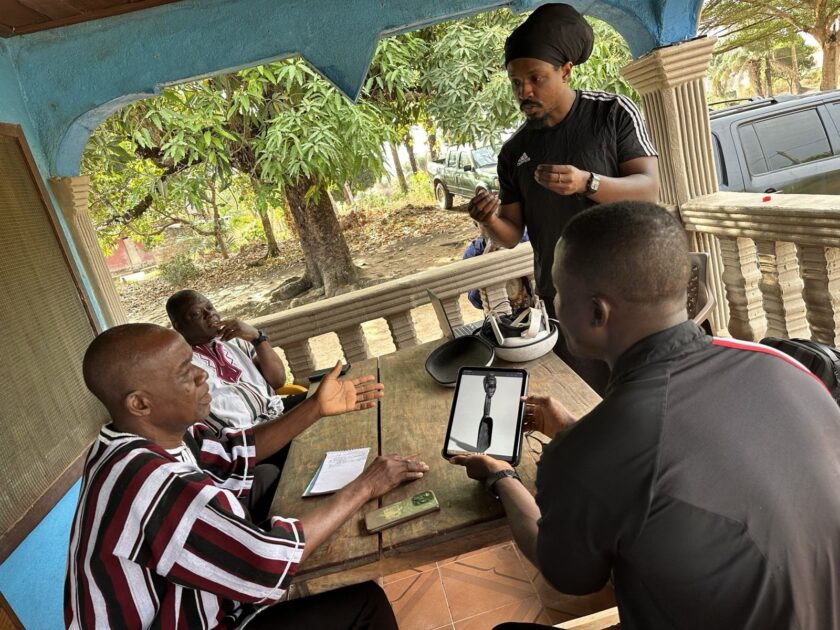
VR-based fieldwork in Sanniquellie, Liberia with colleagues from the National Museum of Liberia and the University of Liberia.
In January and February 2025, I traveled through Liberia with colleagues from the National Museum of Liberia and the University of Liberia. Our fieldwork was conducted under the banner of the Back-to-Africa Heritage and Archaeology Research Project (BAHA) through which I have worked in Liberia since 2018.
Across eight towns and villages in three Liberian counties, we recorded virtual reality supported interpretation sessions with elders, town chiefs, spiritual leaders, artisans, and community historians. Participants encountered interactive virtual 3D models of 13 Liberian objects held in six U.S. museum and university collections. Before traveling, I used photogrammetry and structured light scanning to digitize museum-held objects. The resulting 3D models were accessed through VR headsets. With their virtual hands or controllers, participants intimately examined the art and artifacts while we recorded their memories of the objects, symbolic identifications, and culturally grounded interpretations. These sessions captured community knowledge as digital heritage data that could later circulate through the web and public platforms such as Loci.

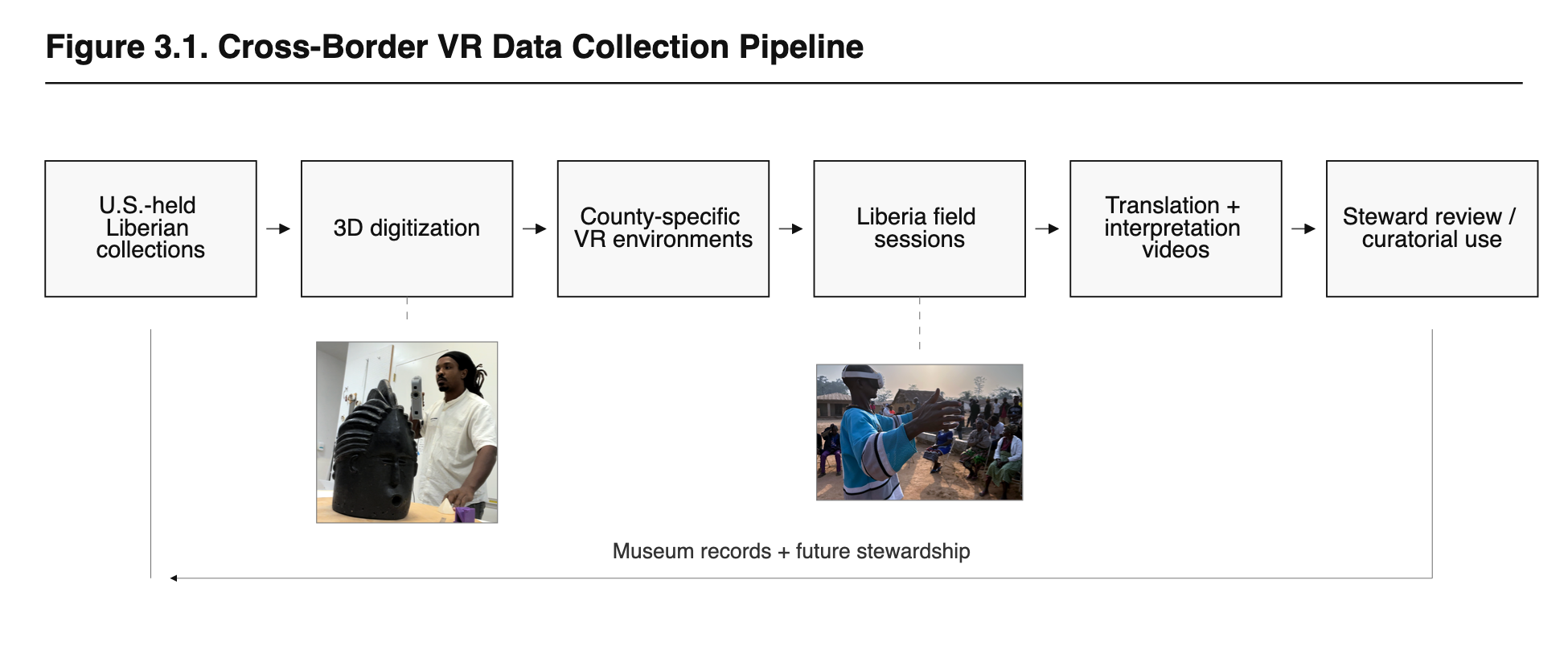
A cross-border digital heritage workflow connecting U.S.-held Liberian collections, 3D digitization, community interpretation in Liberia, and future museum stewardship.
The process generated an extraordinary archive of 3D models, documentary video, transcripts, and community knowledge. It also raised a practical question: Where could this material live?
As part of my dissertation research, I surveyed collection stewards at participating museums and universities. Respondents rated the method highly for accessibility, object research, curatorial relevance, and community engagement. Readiness for integration with collection management systems received the lowest score, with a mean of 2.50 out of five. Respondents cited limited staff time, storage constraints, database compatibility, video support, IT capacity, and presentation design. One collection steward explained, “We don’t have time to fully research all of the objects.”

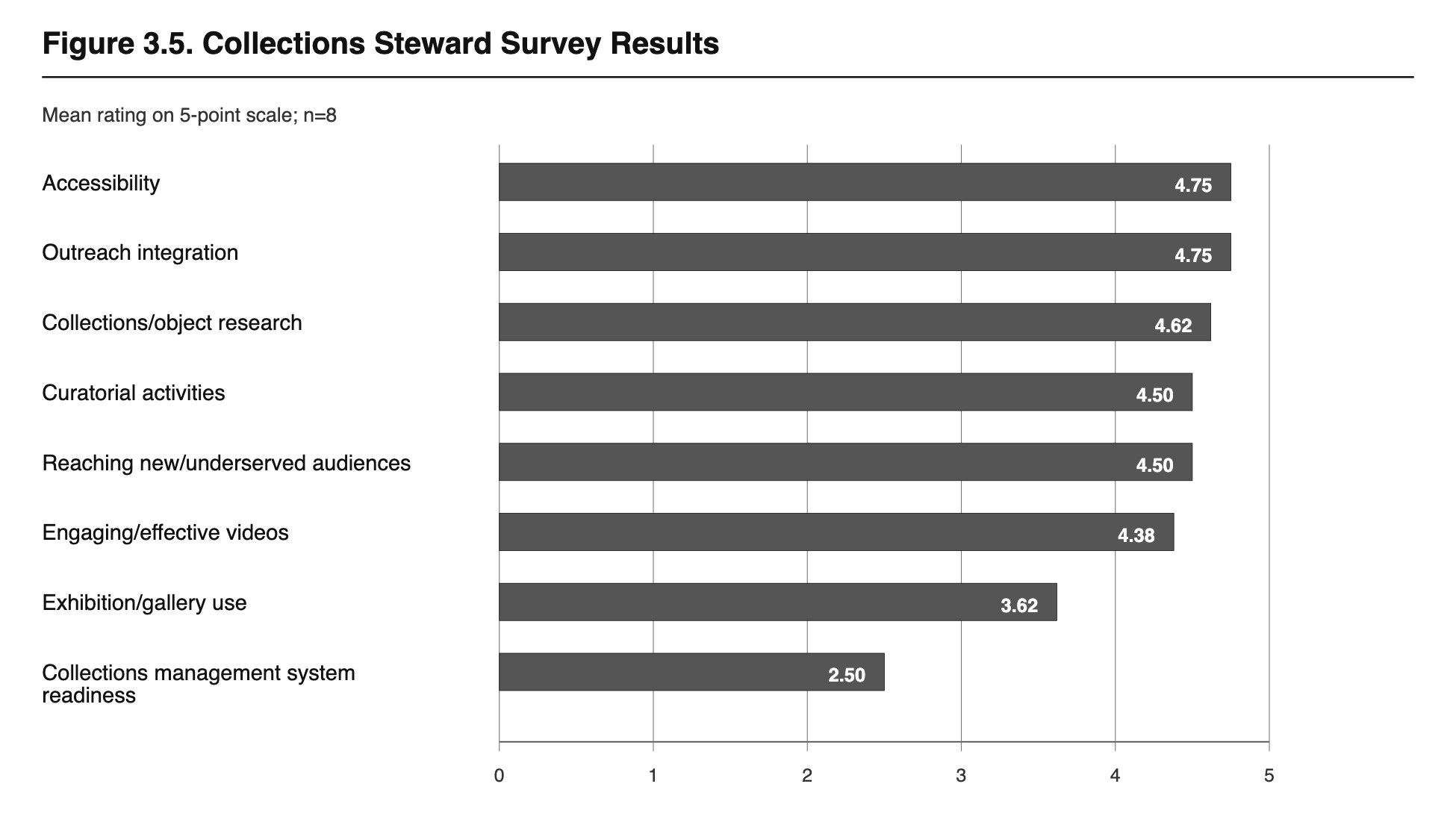
Collection stewards rated the VR interpretation method highly for accessibility, outreach, research, and curatorial use. Collections-management-system readiness emerged as the clearest infrastructure gap.
The curators and institutional staff found the concept and method compelling, but the necessary digital infrastructure required further development. Loci became my response.
Loci is an object-centered, 3D-enabled digital heritage platform that brings interactive models and recorded video interpretation into the same evidence environment. Viewers can examine an object from every angle, explore spatial annotations anchored to specific features, and connect those features to searchable transcripts and precise moments in a speaker’s testimony. Each interpretation links a named knowledge holder, an exact video segment, a transcript passage, the 3D object, and its collection context through a durable citation. This gives community knowledge an academic address.
A user can quote Fatu V. Kamara or Lasana S. Sherif and cite the precise interpretation moment in which their grounded knowledge was shared. Community members become named intellectual authorities within the academic record. Their words can shape object research, exhibition development, classroom teaching, and future stewardship decisions.
Explore Fatu V. Kamara’s interpretation in Loci →

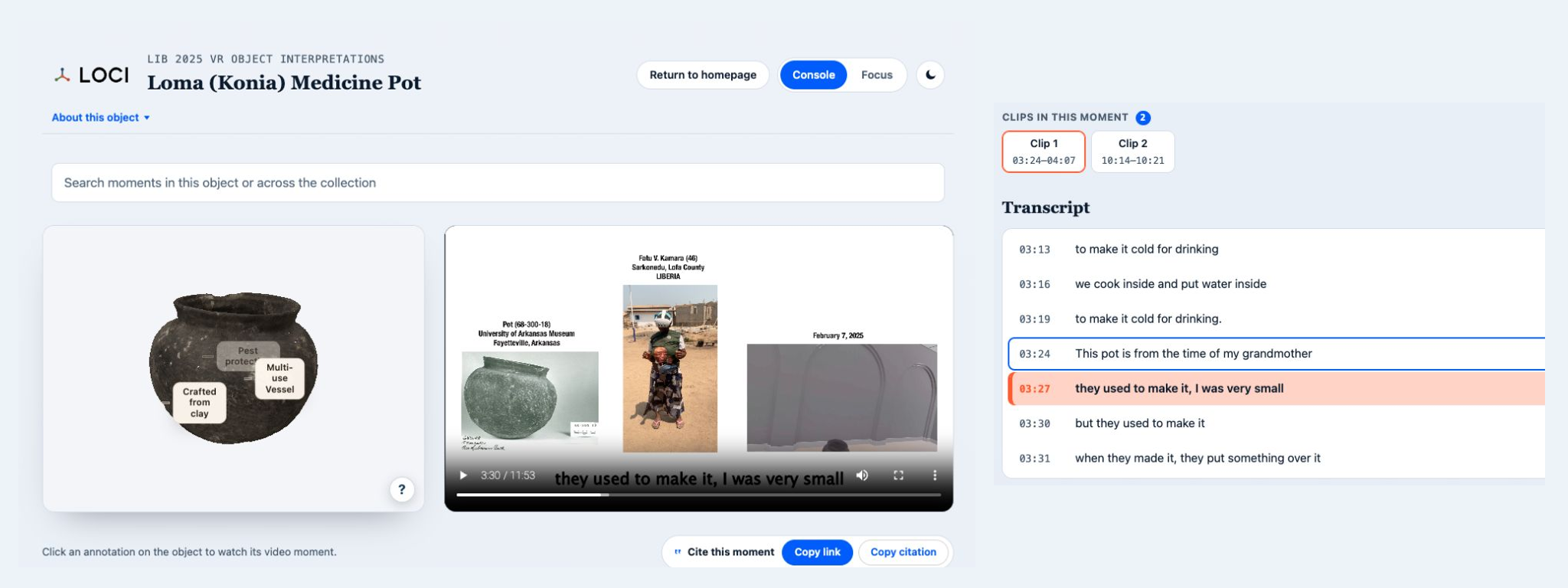
Two views of the same Loci evidence page connect Fatu V. Kamara’s video interpretation with an interactive 3D model of Pot 68-300-18, spatial annotations, synchronized transcript passages, and tools for citing the precise evidence moment.
For me, restorative collection stewardship means rebuilding relationships among objects, source communities, collecting institutions, and public knowledge. Loci turns that principle into information architecture. Its current production pilot connects six collection objects with 42 interpretation clips, 18 spatial annotations, source recordings, transcript search, semantic retrieval, consent-aware attribution, and citation tools.
As an archaeologist and curator, I entered this project with experience in photogrammetry, structured-light scanning, virtual reality, 3D production, documentary media, and digital exhibitions. Application development was a new discipline for me. During my residency in Northwestern IT’s Emerging Technologies Lab, AI coding agents like Codex and Claude gave me an accessible way to translate years of research and curatorial thinking into working software.
I defined how objects, speakers, clips, transcripts, annotations, consent, and citations should relate. I then worked iteratively with coding agents to implement, test, inspect, and deploy those relationships. The process was exhilarating. It allowed me to move directly from a dissertation finding to a technologically sophisticated public interface shaped around the research itself. Coding agents offer archaeologists, humanists, and museum professionals a profound expansion of creative agency. Domain expertise can now guide the construction of powerful public tools.
For Loci, that construction was intentional at every layer. React provides the public-facing browser interface, while Three.js renders interactive 3D models and anchors interpretation to specific parts of their surfaces. FastAPI connects that experience to PostgreSQL, where object records, speakers, transcripts, citations, and publication states remain structured and durable. pgvector supports semantic search, while Redis and RQ move longer-running work into the background so the interface remains responsive. FastEmbed runs on my own machine, converting transcript passages into numerical representations that help Loci recognize related ideas even when speakers use different words. A private authoring environment supports research, rights review, and curation before approved materials enter the public platform. Each component serves a curatorial purpose: reliable evidence, meaningful relationships, responsive media, and accountable publication.
Within this stack, FFmpeg became one of my favorite open-source tools. Created by Fabrice Bellard around 2000 and sustained by a global community, FFmpeg supplies much of the invisible machinery of internet video. In Loci, it converts recordings from different cameras and field settings into consistent, web-ready media, generates precise excerpts and thumbnails, and preserves the timing that connects a speaker’s words to transcripts, citations, and 3D annotations. A recent Lex Fridman conversation with Jean-Baptiste Kempf and Kieran Kunhya captures the ingenuity and generosity behind this work. FFmpeg and Three.js showed me how open-source technical commons expand what coding agents can accomplish. As an archaeologist and curator without a computer science background, I used those agents to understand, integrate, test, and adapt mature tools for a specific heritage mission. Their established foundations gave me the leverage to concentrate on the platform’s cultural and scholarly architecture. Loci grew from that convergence of domain expertise, agent-assisted development, and gratitude toward the public technical commons.
I will continue this work in my new position as an assistant professor in the Department of African and African Diaspora Studies at the University of Texas at Austin. I plan to teach students to wield AI coding agents alongside virtual reality, augmented reality, 3D digitization, photogrammetry, and motion capture. Together, we will explore how these technologies can document cultural traditions, investigate humanistic questions, and create resources that serve communities and public audiences.
Austin’s cultural landscape and collections across the United States will provide new opportunities to expand Loci. Students will help develop pathways for connecting material culture with the voices, likenesses, and epistemologies of the people who know it deeply.
Loci began as the platform my research required. Its future lies in helping communities, students, scholars, and collection stewards build a more connected and citable heritage record.